The Informed Investor · Chapter Thirteen
Understanding the role, the regulation, and the questions worth asking.
What does a broker do, and what sits outside that role?
A broker helps a transaction happen.
That can include identifying properties, communicating between parties, explaining procedures and coordinating the steps.
It is facilitation: not, by itself, investment analysis, and not a guaranteed outcome. Not every transaction involves a broker.
What exactly has your broker been engaged to do?
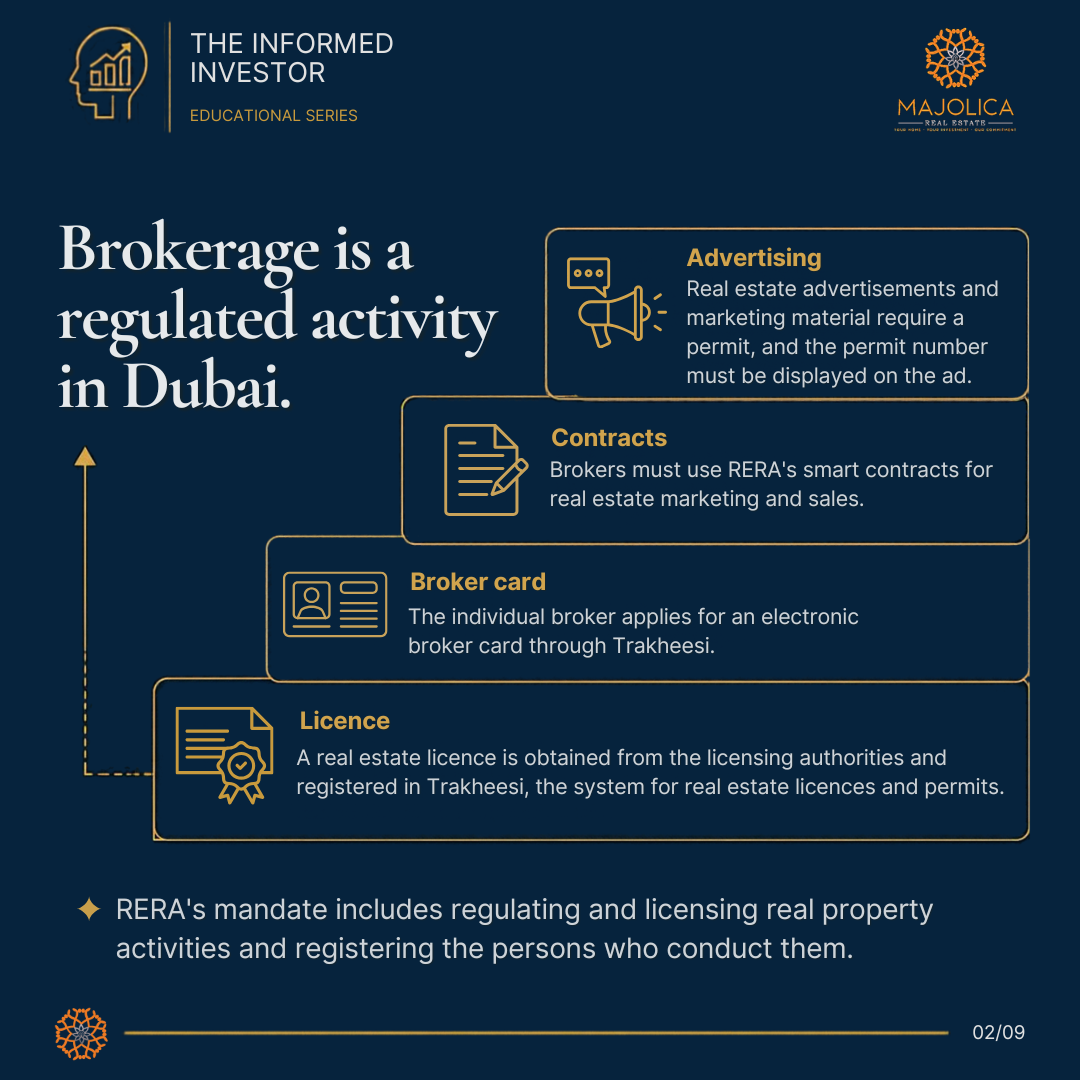
Brokerage is a regulated activity in Dubai
RERA’s mandate includes regulating and licensing real property activities and registering the persons who conduct them.
- Licence — A real estate licence is obtained from the licensing authorities and registered in Trakheesi, the system for real estate licences and permits.
- Broker card — The individual broker applies for an electronic broker card through Trakheesi.
- Contracts — Brokers must use RERA’s smart contracts for real estate marketing and sales.
- Advertising — Real estate advertisements and marketing material require a permit, and the permit number must be displayed on the ad.
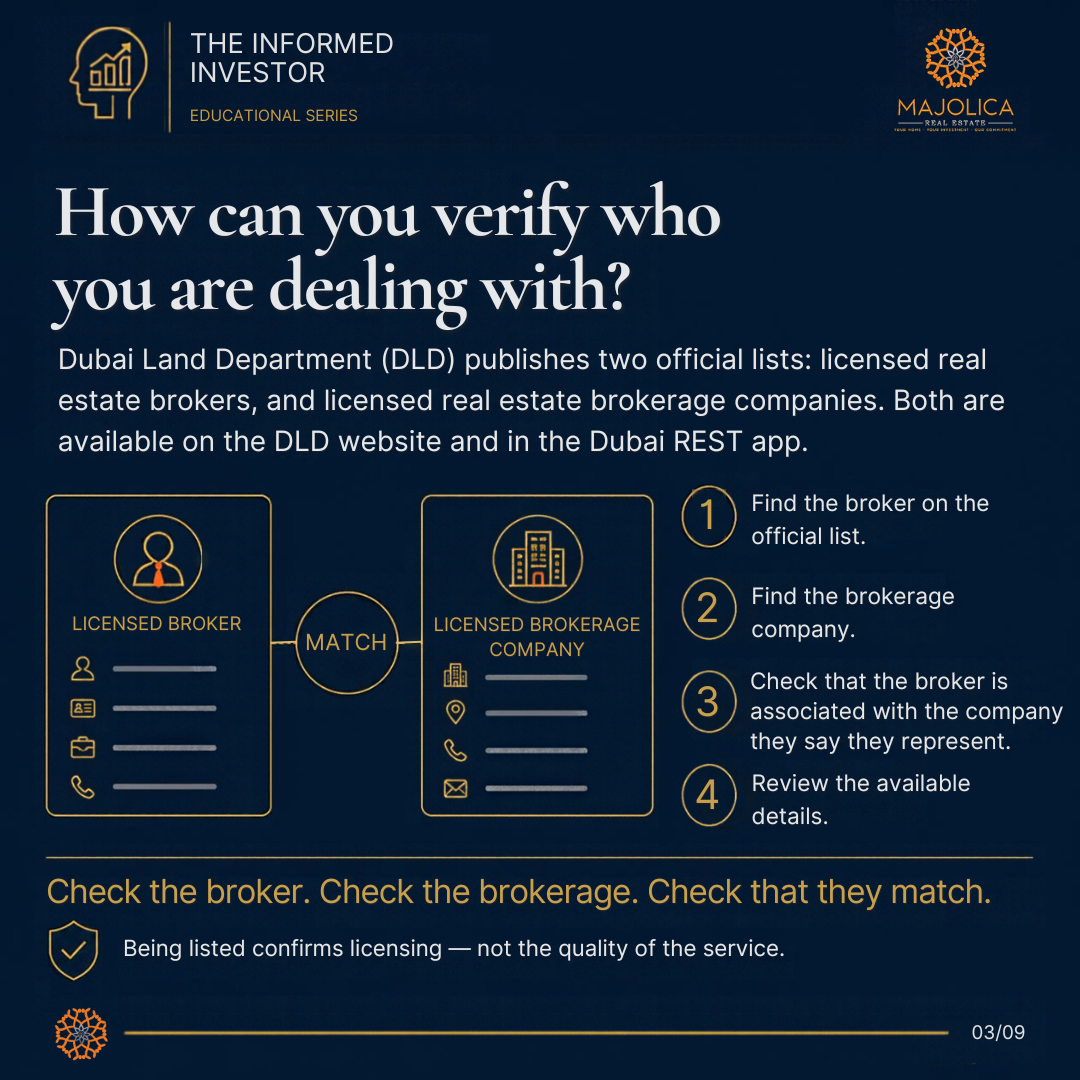
How can you verify who you are dealing with?
Dubai Land Department (DLD) publishes two official lists: licensed real estate brokers, and licensed real estate brokerage companies. Both are available on the DLD website and in the Dubai REST app.
- 01 — Find the broker on the official list.
- 02 — Find the brokerage company.
- 03 — Check that the broker is associated with the company they say they represent.
- 04 — Review the available details.
Check the broker. Check the brokerage. Check that they match. Being listed confirms licensing, not the quality of the service.
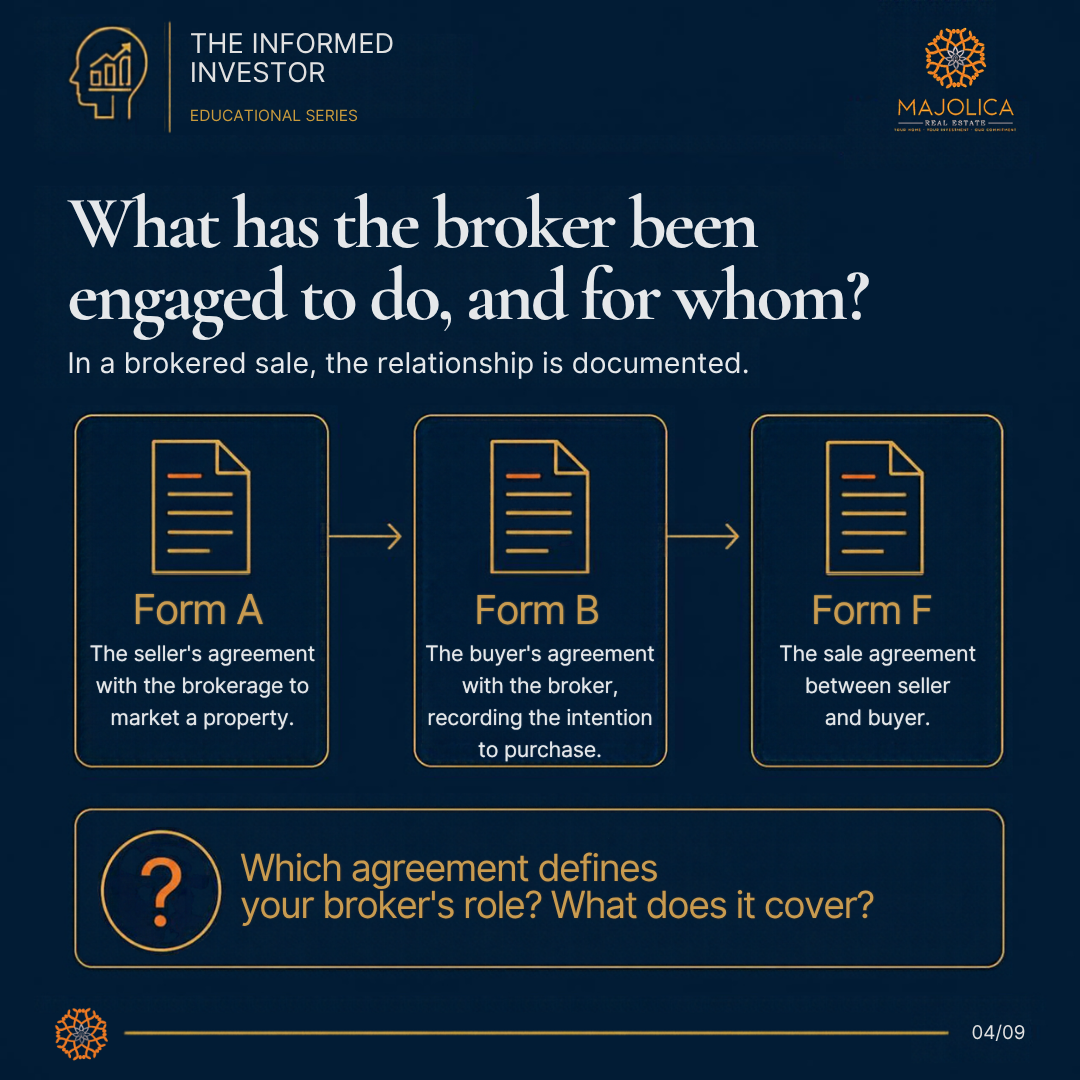
What has the broker been engaged to do, and for whom?
In a brokered sale, the relationship is documented.
- Form A — Seller — The seller’s agreement with the brokerage to market a property.
- Form B — Buyer — The buyer’s agreement with the broker, recording the intention to purchase.
- Form F — Sale agreement — The sale agreement between seller and buyer.
Which agreement defines your broker’s role? What does it cover?
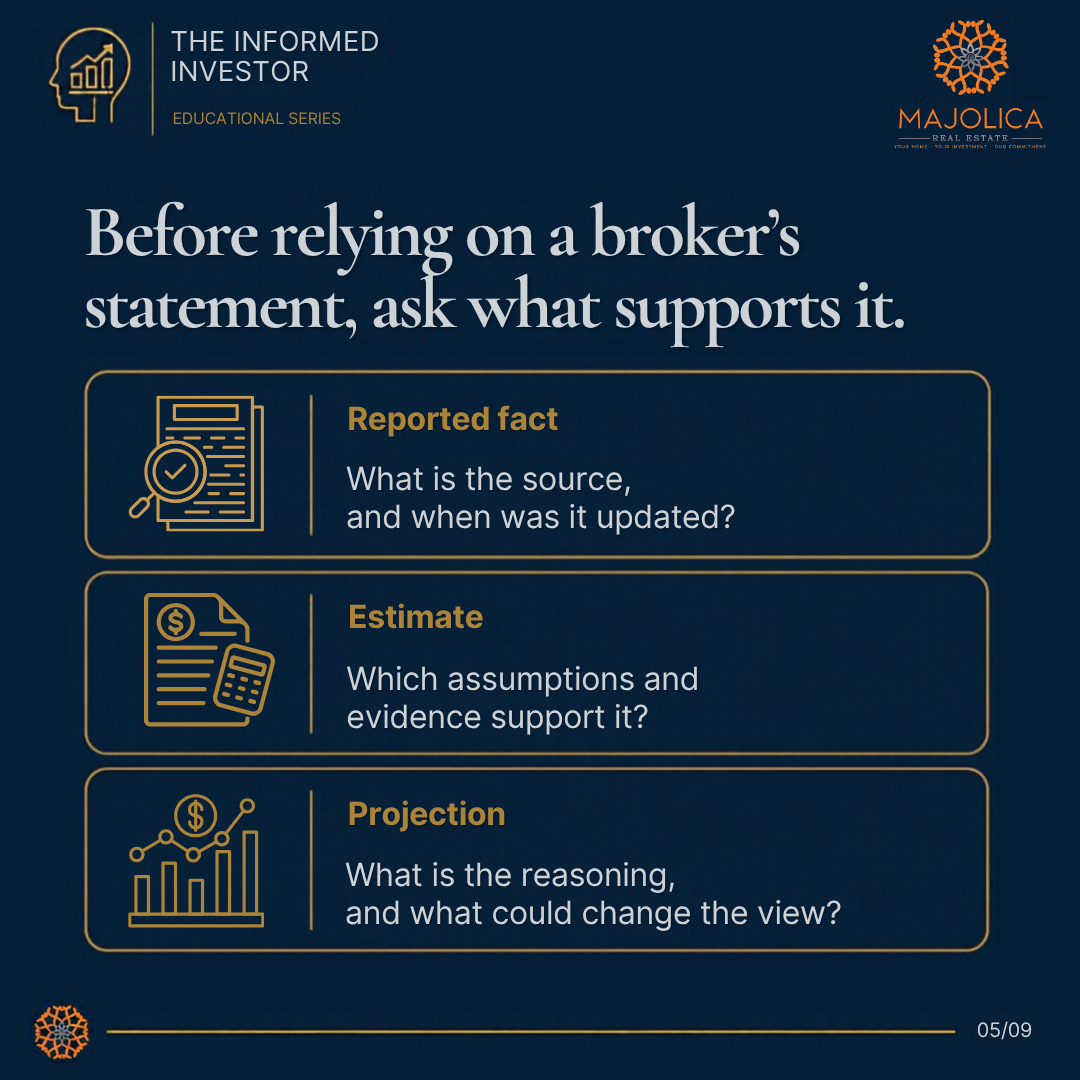
Before relying on a broker’s statement, ask what supports it
- Reported fact — What is the source, and when was it updated?
- Estimate — Which assumptions and evidence support it?
- Projection — What is the reasoning, and what could change the view?
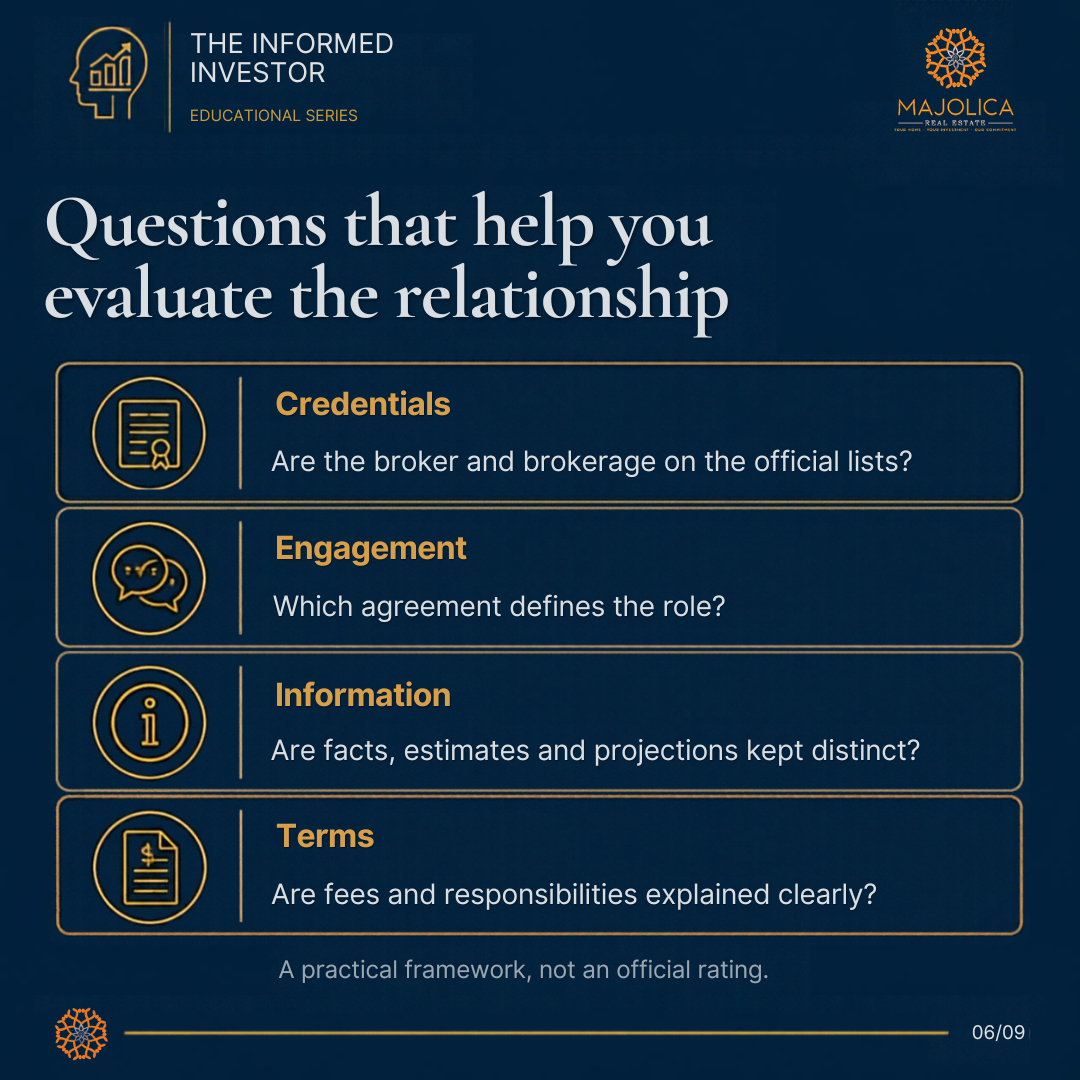
Questions that help you evaluate the relationship
- Credentials — Are the broker and brokerage on the official lists?
- Engagement — Which agreement defines the role?
- Information — Are facts, estimates and projections kept distinct?
- Terms — Are fees and responsibilities explained clearly?
A practical framework, not an official rating.
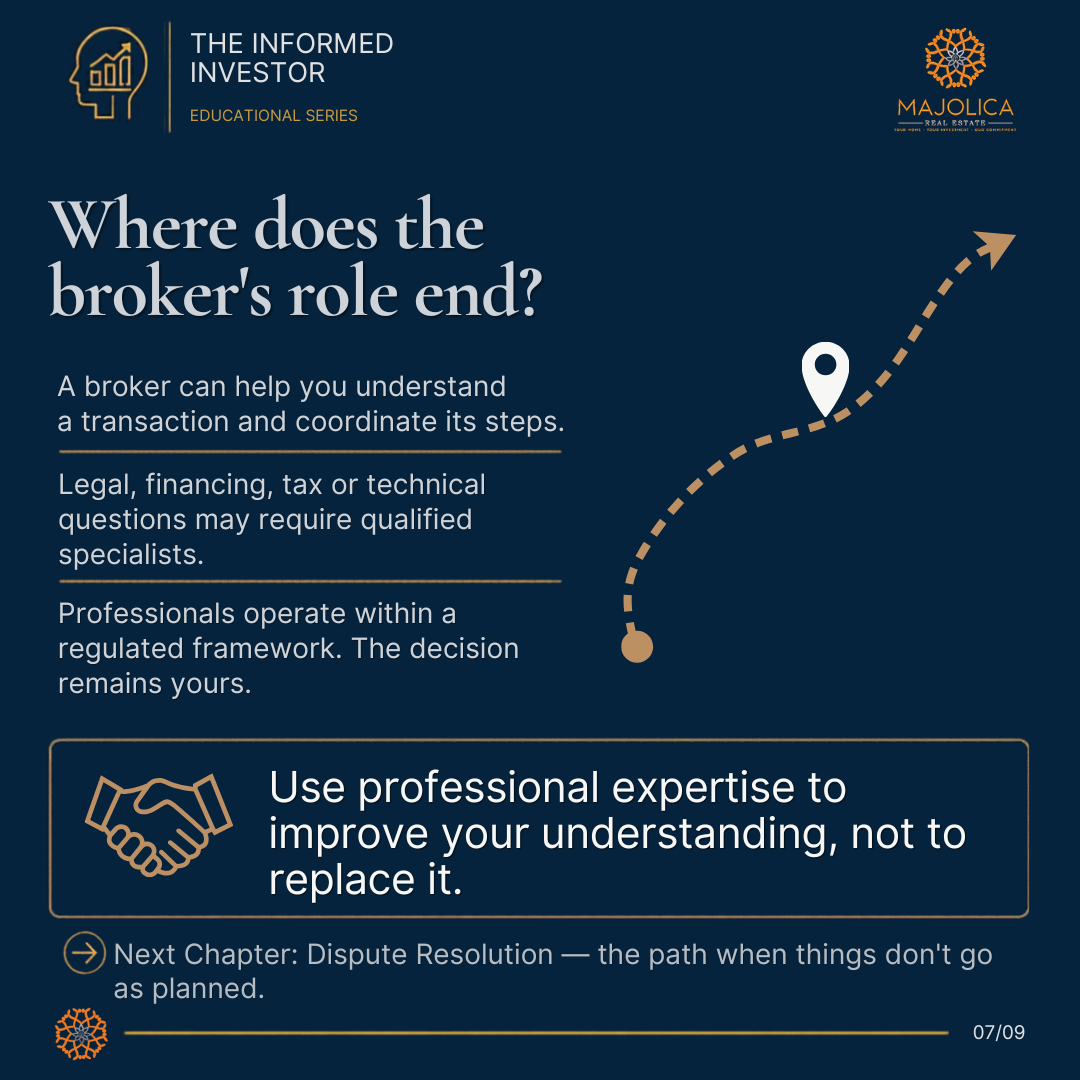
Where does the broker’s role end?
A broker can help you understand a transaction and coordinate its steps.
Legal, financing, tax or technical questions may require qualified specialists.
Professionals operate within a regulated framework. The decision remains yours.
Use professional expertise to improve your understanding, not to replace it.
Understand the role. Verify the professional. Ask better questions.
Next chapter: Dispute Resolution, the path when things don’t go as planned.
Sources and further reading
Dubai Land Department — Official guidance and services
- Licensed Real Estate Brokers (DLD service)
- Licensed Real Estate Brokerage Companies (DLD service)
- Real Estate Brokerage Practice Guide (2024)
- Dubai Brokers — Dubai REST app guide (DLD)
- Real Estate Ad Permit
Relevant legislation
- Law No. (4) of 2019 concerning the Real Estate Regulatory Agency
- Bylaw No. (85) of 2006 Regulating the Real Property Brokers Register in the Emirate of Dubai
This chapter provides an investor-oriented overview of the role and regulation of real estate brokers in Dubai. Procedures and requirements may vary according to the transaction and applicable DLD requirements. It is not a complete statement of the applicable legislation, regulations or procedures. Refer to the current official sources for the full legal and operational framework.
If this question applies to your own situation, we are happy to talk it through. Start a conversation
The chapter as published